Aktywności11 marca 2026
Dwejra, Wardija, Ta' Sarraflu: the finest hike on Gozo
“The Inland Sea, a 2,300-year-old Phoenician sanctuary, Gozo's only freshwater lake, and a frog found nowhere else. 6 km, 3 hours, zero crowds.”
Why this trail?
Gozo's western coast is nothing like the crowded beaches. Between Dwejra and Wied il-Mielah runs a cliff path where in 3 hours you'll pass: the geological marvel of the Inland Sea, an ancient Phoenician rock-hewn sanctuary, Gozo's only permanent freshwater pool, and a rock window that will collapse within decades like the Azure Window.
No tickets. No queues. All you need is water, a hat, and shoes with decent grip.
Getting to the start
From Victoria (Gozo's capital) to Dwejra, take bus 311, but the fastest option is Bolt: 9 minutes, about EUR 8.50 dropped right at the Inland Sea car park. There's no Uber on Gozo, but Bolt works great.
Alternatively: ferry from Malta to Mgarr (approx. 25 min), then bus 311 to Dwejra.
Dwejra and the Inland Sea
Dwejra is one of the most remarkable geological sites in the Mediterranean. The Inland Sea (Qawra in Maltese) is a lagoon roughly 60 metres across, connected to the open sea by an 80-100 metre tunnel cutting through the cliff. Fishermen have navigated this tunnel for centuries.
A boat ride through the tunnel costs EUR 5 and takes about 20 minutes. Worth it even if you're not planning to dive.
Fungus Rock and the tale of a plant
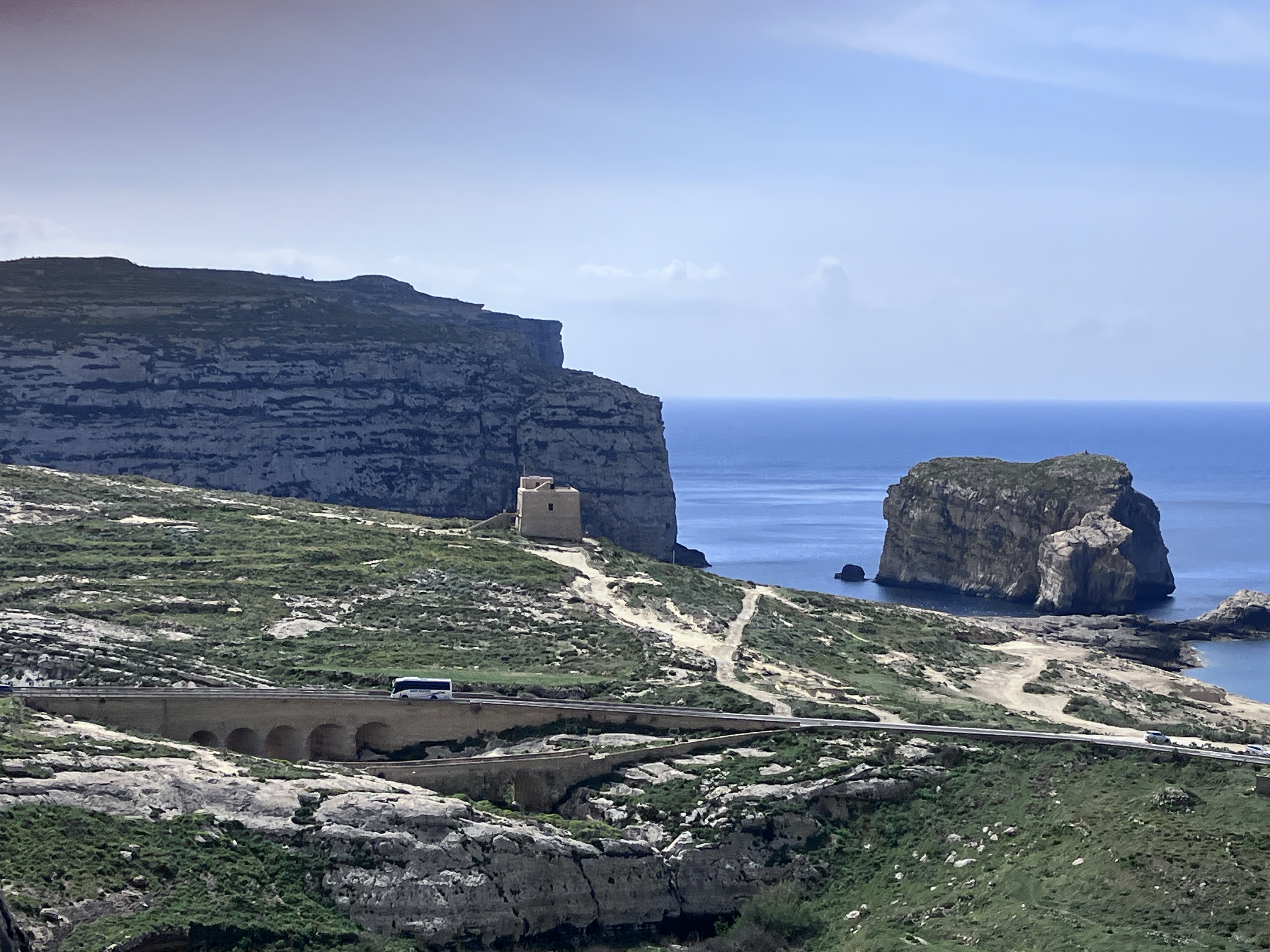
The solitary rock standing in the sea opposite Dwejra is Fungus Rock (Il-Ġebla tal-Ġeneral). On its summit grows Cynomorium coccineum, which the Knights of Malta believed was a miracle cure. Grand Master Pinto in 1746 banned all access under penalty of 3 years rowing the galleys. The rock's sides were smoothed to prevent climbing, and a rope bridge was guarded from Dwejra Tower.
Today Fungus Rock is a nature reserve. You cannot land on it, but the view from the cliffs is phenomenal.
Blue Hole and Game of Thrones
Right beside the Inland Sea is the Blue Hole, a 15-metre-deep sinkhole with an underwater arch at 9 metres. It's one of Malta's finest dive spots.
This is also where HBO filmed the wedding of Daenerys Targaryen and Khal Drogo in Game of Thrones Season 1 (2010). The Azure Window, which served as the backdrop, collapsed on 8 March 2017. Today it's one of the Mediterranean's most popular dive sites.
The entire Dwejra area is Malta's largest contiguous protected area: 8 km2 under Natura 2000 (SAC + SPA).
The cliff path to Wardija
From Dwejra head south along the cliff trail. For the first kilometres you walk across raw limestone garigue, a typical Mediterranean rocky landscape with low scrub. The cliffs drop 120 metres straight down. No railings, no shade, no people.
After roughly 45 minutes you reach the Ras il-Wardija promontory.
Ras il-Wardija Punic Sanctuary
On the edge of a 120-metre cliff, Phoenician sailors carved a sanctuary to the goddess Astarte into the living rock. Dating to the 4th-3rd century BC, it was actively used for some 700 years, through the Roman period.
What you'll see
A T-shaped corridor leads to a rectangular chamber with five large niches cut into three walls, decorated with imitation architectural mouldings. A rock-cut bench runs along the walls for ceremonial banqueting. Also hewn from the rock: a basin with steps (ritual bathing?), a bell-shaped well, and a water reservoir.
The theft and recovery
In 1988, someone cut a carving from the wall of one of the niches using an axe. From living rock. It probably depicted a symbol of the goddess Tanit or a medieval cross. The graffito was recovered only after 23 years, in 2011. You can now see it at the Archaeology Museum in Victoria Citadel (EUR 2 admission).
Breakthrough discoveries (2021-2022)
A team from La Sapienza University in Rome (Federica Spagnoli) discovered pottery fragments inscribed with Astarte's name, confirming a direct link to Tas-Silg, Malta's main Punic sanctuary. A groundbreaking find.
The name "Wardija" is a corruption of Italian "Guardia" (watch post). For centuries the headland served as a coastal lookout.
Note: the land is private (Spiteri family), with no tourist infrastructure. Cliff edges have no safety barriers. The ruins are neglected, but the dramatic setting rewards the effort.
Ta' Sarraflu: Gozo's only freshwater pool
About 150 metres from the sanctuary, in a valley, lies Ta' Sarraflu, Gozo's only permanent natural freshwater body. On this dry, rocky island it's an ecological treasure.
The Painted Frog
An information board by the pool describes the Painted Frog (Discoglossus pictus), the only indigenous amphibian in the Maltese archipelago. The species is legally protected under the Bern Convention and Maltese environmental law.
Sadly, in the 1990s someone deliberately introduced the Levantine Frog (Pelophylax bedriagae), an invasive species from southern Turkey (confirmed by DNA analysis). The aggressive Levantine Frog is displacing the native Painted Frog.
The pool is protected under the EU Water Framework Directive. Surrounded by reeds, trees, and old stone structures, the cloud reflections on a calm day are hypnotic.
Onward to Wied il-Mielah
If you have the energy, from Ta' Sarraflu/Wardija the trail continues north to Wied il-Mielah Window, a natural rock arch over the sea. Often called the "mini Azure Window", it's still beautiful but not eternal.
A 2021 geophysical study (MDPI, Sustainability) rated the arch's safety factor at 3.75 with a collapse probability of 0.5-1.5%. Scientists estimate the formation will survive another 50-100 years. See it before it shares the Azure Window's fate.
Access from Gharb: about 20 minutes on foot. Best photos from the cliff to the right, viewing the arch in profile.
Practical information
- Distance: approx. 6 km (Dwejra → Wardija → Ta' Sarraflu). Add 4 km for Wied il-Mielah.
- Duration: 2.5-3 hours (without Wied il-Mielah), 4-5 hours with it.
- Difficulty: easy/moderate. No steep climbs, but no shade or cliff barriers.
- When: spring (March-May) is ideal, the garigue blooms with yellow flowers. Summer is possible but hot.
- What to bring: minimum 2 litres of water per person, hat, sunscreen, shoes with good soles (not flip-flops!).
- Bolt back: from any point on the trail to Victoria costs about EUR 8-10.
- No facilities: no shops, toilets, or bars on the entire route. Bring everything with you.
The cliff trail along Gozo's western coast is one of those places worth seeing before the rest of the world discovers it. A Phoenician sanctuary on a 120-metre cliff, the island's only freshwater pool, and a frog found nowhere else. And the Bolt ride back costs less than a coffee in Valletta.
#Gozo#hiking#Dwejra#Wardija#Ta Sarraflu#trail#trekking#nature#Inland Sea#Fungus Rock
Powiązane filmy
Więcej filmów →
TikTok
PL
0:11
Przyroda
#polkanamalcie #bluelagoon #maltavibe #boatparty #bbq
Polka z Malty4 mies. temu
132K2K🔥
7.6
TikTok
PL
1:03
Podróże
Wystarczy że w mapy wpiszesz Surfside Sliema, żeby odnaleźć to miejsc...
Polka z Malty3 mies. temu
52K2K🔥
7.6

TikTok
PL
1:04
Podróże
Kiedy żeś nie wziął przejściówki do prądu na Maltę ⚡️🔌 #polkanamalcie...
Polka z Malty6 mies. temu
36K629
7.3

TikTok
PL
1:15
Podróże
Co myślę o wyborze Qawra, St. Paul’s Bay i Bugibba na centrum wypadow...
Polka z Malty4 mies. temu
17K238
7.3
Planuj wyjazd na Maltę i Gozo
3000+ sprawdzonych ofert noclegów, wycieczek, aktywności i pojazdów.