100 pts4 min read🌊 any🟡 medium
The Ggantija temples on Gozo are over 5,500 years old, predating the Egyptian pyramids. Megaliths weighing over 50 tonnes were moved on stone ball bearings.
Older than the pyramids
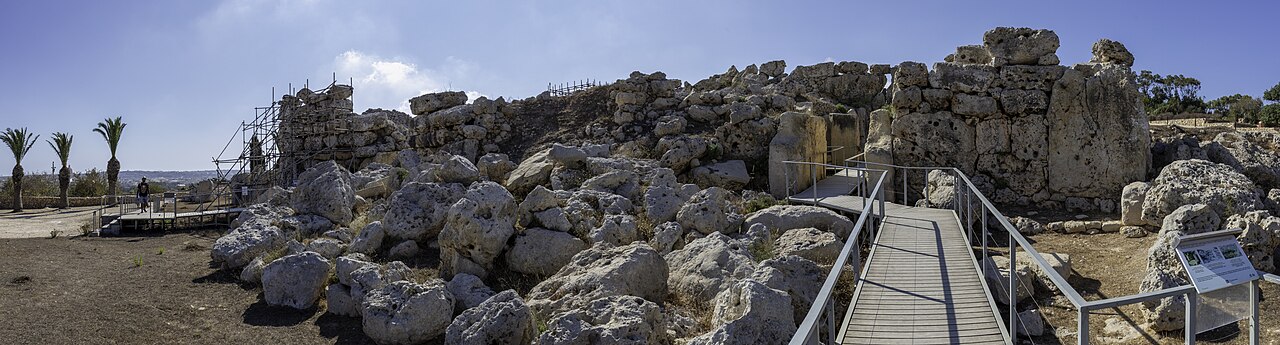
The Ggantija temples are two megalithic sacred complexes dating to approximately 3600-2500 BC. At over 5,500 years old, they rank as the world's second-oldest freestanding stone structures, after Gobekli Tepe in Turkey. For comparison, the Great Pyramid of Giza was built around 2560 BC, over a thousand years later.
Colossal blocks without wheel or metal
The name Ggantija derives from the Maltese word ggant, meaning giant. Legend says the temples were built by a giantess who nursed a baby while carrying the stones. In reality, Neolithic builders had neither the wheel nor metal tools. They used small stone spheres as ball bearings to transport blocks, some weighing over 50 tonnes, twenty times heavier than the average block in the Great Pyramid. The southern temple reaches 6 metres in height.
UNESCO and archaeological discoveries
Ggantija was inscribed as a UNESCO World Heritage Site in 1980, the first of Malta's megalithic temples. In 1992, the listing was extended to include five more temple complexes. Archaeological work has uncovered ritual oils, pottery fragments, and traces of animal sacrifices. The distinctive clover-leaf shape suggests each apse served a separate sacred function.
The interpretation centre
A modern interpretation centre opened in 2013 guides visitors through Gozo's Neolithic history, with original artefacts, 3D reconstructions, and a model showing the complex at its peak. Adult admission is EUR 9 (2026).
Practical tip: Visit first thing in the morning when gates open at 9:00. You will avoid tour groups and have ideal light for photographs. The ticket also covers the interpretation centre.
🧠 Test your knowledge
How old are the Ġgantija Temples?
Click an answer! +10 bonus pts in-game after check-in.
Tip
Visit the heritage museum first for context. Open daily 9-17, last entry 16:30. EUR 9 adults.
Check in here
You haven't joined the game yet
Gallery


Trails through here
Nearby
🚤40 pts~370 m · ~5 min
Ninu's Cave
Ninu's Cave in Xaghra was discovered in 1888 by Joseph Rapa while digging a well. A 4-metre spiral staircase leads to a 20x8 m chamber with stalactites.
🚤40 pts~630 m · ~8 min
Xerri's Grotto
Xerri's Grotto in Xaghra was discovered in 1923 by Anthony Xerri while digging a well under his house. A 10-metre spiral staircase leads to a cave of stalactites.
🚤50 pts~1.7 km · ~21 min
Calypso's Cave
Calypso Cave above Ramla Bay is traditionally identified with mythical Ogygia, where the nymph Calypso held Odysseus captive for 7 years according to Homer.